|
|
528 Chama, N.E., Albuquerque, NM 87108 http://www.cbass.com |


From The Desk Of Clarence Bass
By Clarence and Carol Bass
|
|
Assessing Your Balance
Kaitlyn Buckwell, a strength and conditioning specialist with the Center for Sports Performance and Research says that you should approach balance like any other part of your fitness. Take the following four-stage balance test which is a simple baseline assessment used by physical and occupational therapists as published by Harvard Health Publishing online.
The test measures how long you can stand in a series of positions, each progressively harder. The goal is to maintain balance for 10 seconds without needing support.
The protocol:
The tests are to be done barefooted with your arms at your sides or extended out, and your gaze straight ahead. For safety reasons they advise doing them near a wall, chair or person in case you need help.
The exercises - as they describe them:
1) Side-by-side. Stand on a flat surface with your
feet positioned next to each other so they touch. Hold the position
without moving your feet. 2) Semi-tandem. Place the instep of the arch of one foot so it's next to and touching the big toe of the other foot. Hold the position without moving your feet. Switch foot positions and repeat.
3) Tandem. Place one foot in front of the other, so the heel and toes touch. Hold the position without moving your feet. Switch foot positions and repeat.
The results: If you can't hold the last two positions for 10 seconds, or cannot progress to the last two positions, they recommend you see a physical therapist who can help you through exercises that "increase joint stability, mobility, and strength."
If you try the test you will see that it is a pretty basic assessment, but they offer more advanced tests:
Single leg variation (see single leg above): Hold the position for as long as possible, aiming for 30 seconds which they define as good balance. They note that there may be a variation between your right leg and left because most people have a dominant leg. This could help you identify a muscle balance that needs attention.
Heel-to-toe walking: Assume the tandem position (above), walk as though you are on a tightrope for 10 steps, then turn and walk back to the starting point, aiming to complete it in 20 seconds or less. This not only tests your balance, but your coordination and body awareness.
Timed up and go (TUG): From a seated position, stand and walk in a straight line at normal pace for 10 feet, turn, walk back and sit, aiming to complete it in 12 seconds or less. This tests functional mobility and fall risk.
They conclude with the disclaimer that the results of the tests should never be used as a substitute for direct medical advice from your doctor.
My Take
Most people reading this website already have in place aerobic and weight training. Both of these reshape the body in ways that make balance easier, more instinctive, and better when under stress.
Here are some of the advantages both sports provide that directly support stability.
Resistance training: balance depends on strong glutes, quadriceps, hamstrings and calves: stronger muscles provide better control of body mass. Resistance training also strengthens tendons and ligaments which helps stabilize the ankle, knee and hip - key joints for balance. Athletes have improved coordination which increases reaction speed if their balance is challenged to prevent a fall.
Aerobic training helps improve circulation, helps with a smoother walking or running gait, and develops endurance so that fatigue is delayed and balance loss is avoided.
Together they help to create a body with better balance.
That said, dedicated balance exercises are still worth adding because balance is a skill and skills need practicing. Balance exercises can give you better and faster body coordination and control.
So take Ms. Buckwell's advice and incorporate some balance training in your fitness routine.
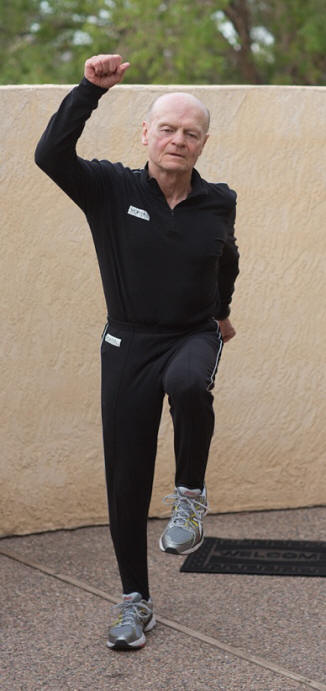
Photo by Laszlo
Marching in place is a good beginner's balance exercise,
building single-leg stability.
Using only the legs with arms at sides
to begin, raise one knee to hip height, then alternate legs, continue for 20 to
30 seconds.
March 1, 2026
Comment on this article: FEEDBACK Ripped Enterprises, P.O. Box 51236, Albuquerque, New Mexico 87181-1236 Home | Products Index | Ripped Bks | Lean Adv. Bks | Lean For Life | Recommended Bks | |Consultations | Tapes | To Order | Feedback] Copyright © 2026 Clarence and Carol Bass. All rights reserved.
|