|
|
|


| Home | ||
| About Clarence Bass | ||
| Pictorial | ||
| Philosophy | ||
|
Products Books, DVDs, Consultations Photos, Posing Trunks, Etc. |
||
| Order | ||
| Feedback | ||
|
Articles:
|
||
Fitness Success
Stories (22)
We've heard
many success stories over the years, and here are some of them that are
particularly noteworthy and inspiring.
Training With
Resistance Bands
by Richard A. Winett

Clarence with Richard, friends and correspondents
for over 40 years.
Background
I have been resistance training for almost 70 years having started as literally a kid. During that time I trained in some excellent gyms and at one time had a 1600 square foot gym in the lower level of our house with a great array of resistance machines, free weights, chin and dip set ups, squat and other racks plus an array of aerobic training machines. I had that set-up for many years and then when we sold our large house (and did not take any of the equipment), and moved to a smaller, townhouse, I trained at an excellent, very well-equipped gym less than 10 minutes from our house. Because I had good control of my work schedule I was able to train at a time when this gym was almost empty.
When traveling or on vacation, I also beforehand, would check out the gyms and more or less be able to train the same way I trained at home. Once in awhile when I knew things would be hectic, I would do some training with resistance bands as more or less a ‘filler’.
In early 2020, I retired and we moved from Virginia to the Charleston area in South Carolina. I also had a very bad fall on black ice in Virginia and had a serious leg injury. I had extensive PT but I did want to get back to real training.
It was soon the Covid era and there were restrictions on training in gyms plus I did not like having to wait around to use machines or any other equipment and the gyms were not all that good. As part of my PT I was using resistance bands mostly for some leg movements and then would stay around and do some upper-body bands movements.
Complete Resistance Bands Training
As noted I had some experience with resistance bands but mostly saw them as a ‘filler’ or second choice not my prime tool for training. I soon realized that some of the advantages of bands are that for very minimal cost and in minimal space I could do a great variety of movements with no interruptions and with practice, some real precision. It also made sense to do whole body training and not my former split routines. I could do one exercise after another after some brief prior practice of how to perform each exercise. And, to go back to a legend in bodybuilding, with bands I could do a whole-body routine similar to what the legendary Steve Reeves had used 70 years ago!
My Routine
My gym is basically a bedroom but could be virtually any room in a house or apartment. Given I am not using heavy weights or for that matter very low reps with bands, I do not do any specific warm-up. I simply begin with the first exercise. I also take very little time between sets because even though I take each set to the last good repetition, it is not as taxing as using heavy free weights or some machines although I still do a few body weight movements. It also would make the whole session boring and very long for me if there was a lot of time between sets.
The entire three-times per week routine takes 25-30 minutes and then is followed by sprint intervals that will be described later. For most movements I am using three ‘heavy’ bands that are simply placed together one on top of the other so they are easy to hold and keep in place. My repetition format is about 3 seconds positive and 3 seconds negative with some variation based on the range of motion. I also have the routine written-out in my training notebook beforehand and simply after performing several exercises in a row will record the number of repetitions I performed. At the end of the routine I will note the time it took to completion and then also rate myself on what I see as important dimensions on a 1-10 scale: Form, Focus, Effort, Satisfaction.
Here is the routine: Chest Press, Fly, Rear Delts, Row, Shrugs, Shoulder Press, Lateral Raise, Dips (using a chair), Pulldowns, Pushdowns, Triceps Extension, Curl, Squat, Deadlift, Stiff Leg Deadlift, Lunge, Side Bend, Crunch, Twisting Rotary Movement, Leg Extension and Leg Curl (seated), Forearm Curl, Reverse Forearm Curl, Abductor-Adductor, Grip (using a device), 4-Way Neck (just hand resistance), Regular Push-ups.
I will then take a couple of minutes break and do a simple sprint interval routine, running a bit in place and using a great deal of arm motion: Easy Walk for One Minute; then 3 x 20 seconds at maximum effort with one-minute easy walking in between. For each 20-second sprint, I quickly take my heart rate and then do a three-minute easy cooldown taking my heart rate at two and three minutes to assess heart rate recovery which is an important fitness and health indicator. By the three-minute point, my heart rate is still about 20% over normal which is reasonable after such as intense protocol and usually after about 10-15 minutes, my heart rate is back to its normal range.
Even with such hard training, I still walk about 6500 steps per day but that is very easy walking and where we live in the Charleston, SC area, there are no hills.
Conclusions
I realize by resistance training with bands this way at home while it is very efficient, I am missing one element. That is, I am using a lot of tension and effort but there is nothing that I am lifting that is actually heavy as with free weights and machines. That could be rectified by once or twice per week performing 3-4 free weight or machine exercises such as leg press, chest press, rows, and shoulder press, for example. This likely would generalize more than bands to lifting something heavy in real life such as carrying and walking with heavy food shopping bags.
One key point to keep in mind with any routine you develop. It is my preference to train hard and I look forward to the workouts and training very hard. I think that training this hard is not necessary especially if it is not a preference. Keeping a couple of repetitions in reserve likely would be as effective and likely make recovery easier. Another key point though is that I have found that recovery from resistance bands training is pretty easy requiring nothing special. I suspect at this point if I was still using free weights and machines even with lower volume than my resistance band routine I would experience a lot of soreness and find recovery difficult. So, while resistance band training can be performed at any age, it may be especially helpful as we get older.
July 1, 2026
Comment on this article: FEEDBACK
Fit Senior Handles Aging
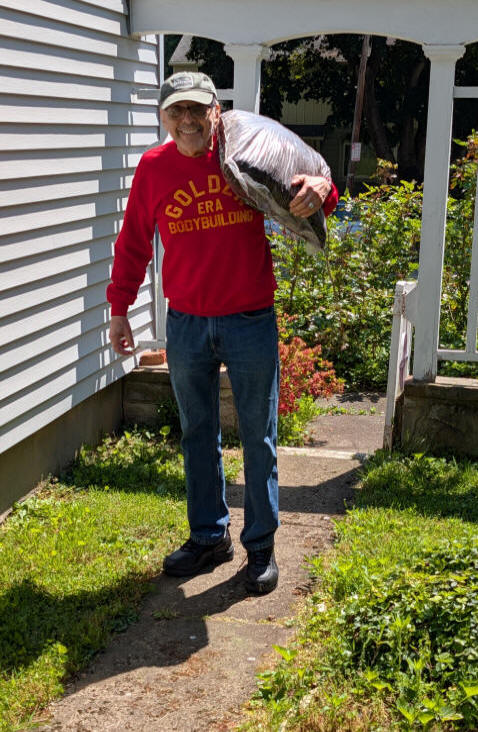
Gerald carrying 40 lb. bag of mulch from car to yard
(85 ft. plus eight stairs)
At age 91, my "success story" includes 73rd continuous years of weight lifting, which began in 1953, on my 18th birthday, using the York "Big 10" lifting set and advanced to Olympic lifting, then powerlifting, and, in recent years, bodybuilding (or, at 91, "body preserving as best I can").
My current story continues to include looking forward to each workout in our basement gym with the same enthusiasm I had nearly 3/4 of a century ago. Certainly "success" at this stage in my lifting is more challenging, especially as sarcopenia continues to be an ever-more-formidable adversary. Nonetheless, each workout begins with Tom Petty blaring, "No, I Won't Back Down!," a song whose power isn't in encouraging a foolish belief that my poundages will not decrease; rather, the song generates a determination to lift enthusiastically, smartly and seriously, to put maximum effort into each rep and each set and, thereby, promote the most strength and muscle possible at my age.
On days between lifting workouts, I trek (using trekking poles) for an hour, up and down slopes in a nearby park. I trek year-round, although, when I turned 90, I began using a treadmill when the outside temperature drops below 15 degrees or rises above 89. Yes, at 16 degrees and above, I bundle up my mighty 91-year-old body, and with a smile on my face, I head for the slopes.

I alternate these workouts but, acknowledging advanced years and a changed physiology, I schedule one rest day/week.
In the last couple of years I've experimented with 2-sets vs. 3-sets workouts. Research prompted me to use two sets because that scheme promotes more intensity in each set through a full-body workout. However, recently I've returned to 3 sets after research persuaded me of the benefit of extra volume. My 3 sets employ drop sets, with each reduction in weight involving a few more reps. That helps prevent overstraining my not-so-youthful body (and is, for example, substantially different from my 5x5 workouts on the major lifts back in my powerlifting days). I'm also aware that I'm an ever continuing work-in-progress and might make new changes as time-and-tide impact my physical abilities. When I reached 90, I became acutely aware that my goal had, more than ever, become slowing the rate of muscle loss and strength; building muscle and strength, as I had in earlier years, was over.
One certainty for me, with respect to continued health, is the benefit of the plant based eating I've followed for the past 22 years. On the other hand, I'm aware that the diet, especially if one is a vegan, requires some supplementation, particularly with respect to adequate protein for an older (very old!) vegan-bodybuilder. Consequently, I have a daily pea protein drink (sipped through the day), with about 40-50 grams (I use NorCal, a very clean pea protein).
"Success" does not have the meaning it had nearly 3/4 of a century ago. The fact that I'm even writing this underscores that sensible lifting, nutrition and physical adaptation can help create one kind of "success story" we all hoped to create when first wrapping our hands around a barbell.
A final observation: I think it's critical to maintain a sense-of-humor when confronting the benefits and limitations of bodybuilding and good health practices in advancing years. I keep in mind an old joke about the optimist who fell from the top floor of a 20-storey building, who was heard to exclaim as he past each floor: "so far, so good, so far, so good."
Gerald Coles
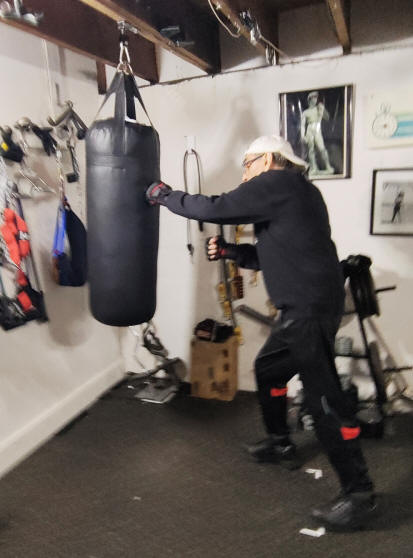
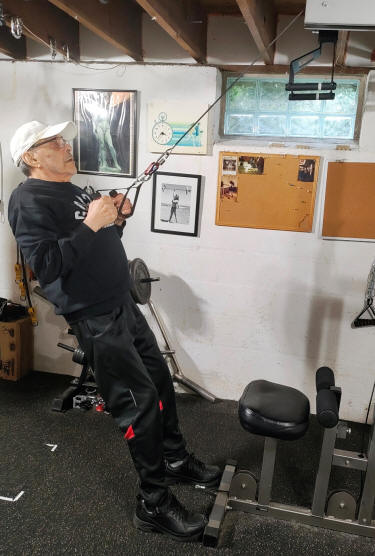
Heavy bag work for dynamic power
Pulldown variation to keep interest
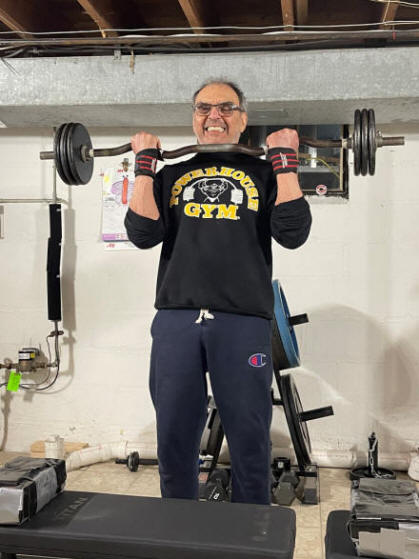
Curling with York curling bar
(We have one just like it. Treasure it!)
Onward!
June 1, 2026
Comment on this article: FEEDBACK
Ripped Enterprises, P.O. Box 51236, Albuquerque, New Mexico 87181-1236
or
street address: 528 Chama, N.E., Albuquerque, New Mexico 87108,
Phone (505)
266-5858 , e-mail: cncbass@aol.com ,
Office hours: Monday-Friday, 8-5, Mountain time
Home | Products Index | Ripped Bks | Lean Adv. Bks | Lean For Life | Recommended Bks | |Consultations | Tapes | To Order | Feedback]
Copyright © 2026 Clarence and Carol Bass. All rights reserved.